The measurements taken before lens surgery, and why they matter more than the surgery
The twenty-minute operation is highly standardised; the result is largely decided beforehand, by measurements most patients never see explained.
By Ms Li Jiang MBChB (Hon) FRCOphth CertLRS · Published 14 August 2026
Clinically reviewed by Ms Jiang on 14 August 2026
Stock photograph — https://www.pexels.com/photo/5765827/
The operation itself is short and highly standardised: a small incision, the natural lens removed, an artificial one put in its place, about twenty minutes from start to finish. What actually decides whether the result feels sharp afterwards is not what happens in theatre — it is a set of measurements taken in the weeks beforehand, and they matter more than the surgery does.
What is actually measured
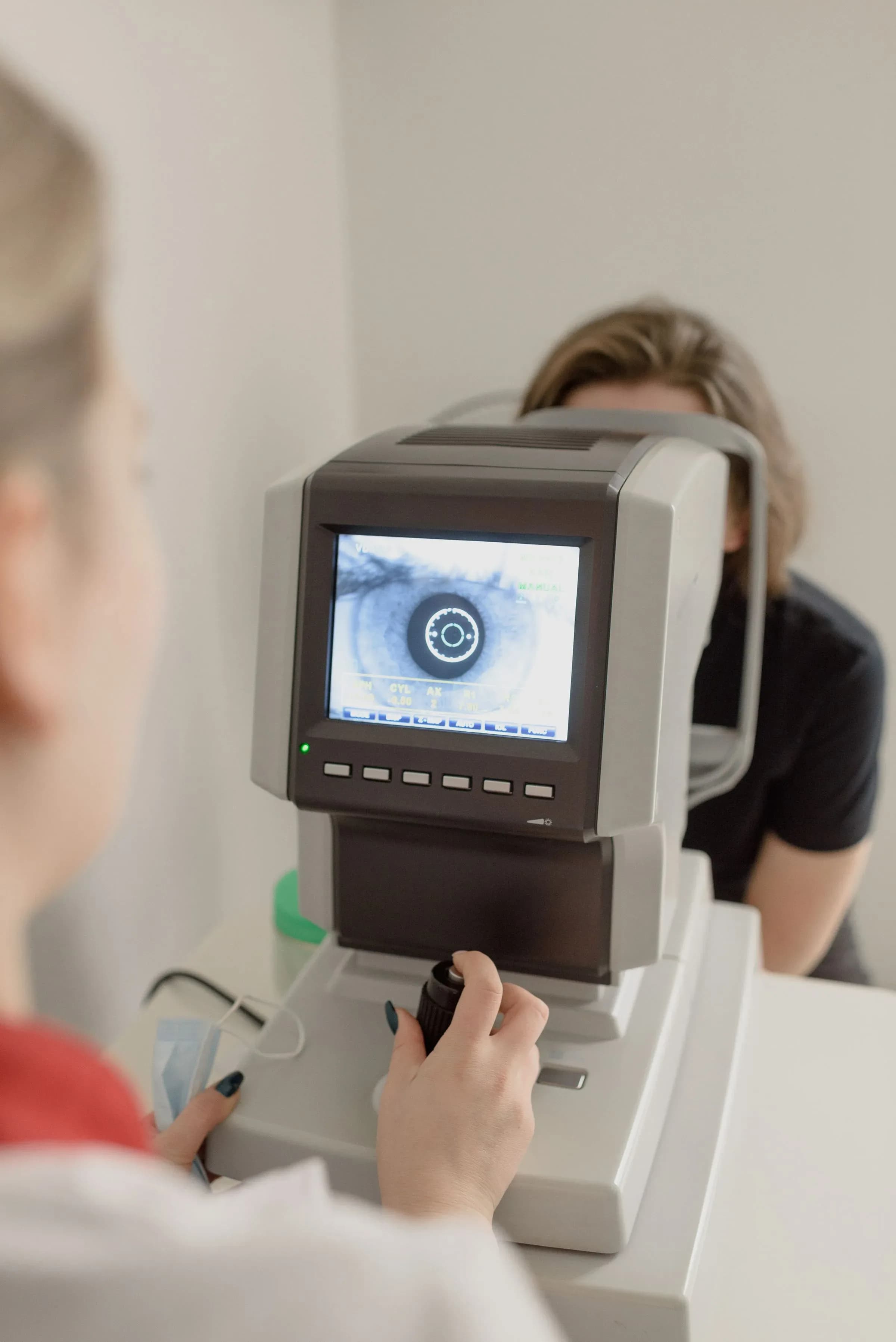
Several dimensions of the eye are recorded, usually in a single unhurried appointment using non-contact scanning devices rather than anything applied to the eye itself.
- The axial length of the eye — its length from front to back, the single measurement the calculation is most sensitive to
- The curvature of the cornea, front and back
- The depth of the anterior chamber, the space between the cornea and the natural lens
- The amount and axis of any astigmatism, so a toric implant can be aligned correctly if one is needed
How a number becomes a lens power
A formula combines these measurements to calculate the power of the artificial lens expected to leave the eye focused where you and the surgeon have agreed — usually distance vision, sometimes a different target by design. Several formulas exist, and different ones perform better on unusually long, short or previously operated eyes, which is one reason the choice of formula is itself a clinical decision rather than a fixed calculation everyone runs the same way.
Why some lens choices are less forgiving of a small error
A standard single-focus lens tolerates a small miss reasonably well — the result may need glasses for some tasks rather than none, which is disappointing but not disruptive. A toric lens correcting significant astigmatism, or a multifocal lens designed to reduce dependence on reading glasses, is less forgiving: the whole reason for choosing it depends on the calculation landing close to its target, and a small error is more noticeable in the everyday result. This is one of several reasons the measurement stage deserves more attention, not less, when a premium lens is being considered.
Why the result is a prediction rather than a certainty
Even with careful measurement, the outcome is a prediction, and the main reason is not measurement error. Once the natural lens is removed, the artificial one settles into a healed position inside the eye that cannot be measured in advance — only estimated from how eyes like yours typically behave. Small differences between the estimated and the actual healing position are the largest single source of any gap between the planned and the achieved result, and no scan can close that gap completely, because the thing it would need to measure has not happened yet.
Previous laser eye surgery complicates the calculation
Standard formulas assume a cornea that has never been operated on. LASIK, PRK and LASEK all reshape the cornea in ways that change the relationship between its front and back surfaces, which is exactly the relationship the calculation depends on. There are corrected formulas for eyes with a history of laser refractive surgery, but they only get used if that history is declared — always mention previous laser surgery, even if it was decades ago, even if you cannot remember which type, and even if the practice that did it no longer exists to provide records.
Dry eye distorts the measurements
The measurements are taken through the tear film sitting on the cornea, and an unstable tear film gives inconsistent readings from one visit to the next — not because the eye has changed, but because the surface being measured is uneven in a way that varies through the day. Treating dry eye before biometry, even briefly, often improves the consistency of the readings enough to be worth the delay.
Why contact lenses have to come out beforehand
Soft contact lenses temporarily reshape the cornea, and the shape only relaxes back over some days once lenses stop being worn; rigid and gas-permeable lenses take longer, sometimes weeks. Measurements taken while the cornea is still under that influence describe a shape that will not be there once the eye has recovered its normal contour, and the calculation built on them is wrong from the outset, however carefully everything after that point is done.
What is worth asking
Two questions are worth putting directly to whoever is doing the measuring. First, whether the measurements are taken on a second device as well as the first, and what happens if the two disagree — repeat measurement is one of the more effective ways of catching an outlier before it becomes a lens choice. Second, what the plan is if the result misses the target once healing is complete: whether that is monitored, at what point it is considered worth acting on, and what an enhancement would actually involve.
It is reasonable to expect this appointment to be unhurried, to have each measurement explained rather than simply read out as a number, and to be told plainly if anything about your eyes — previous surgery, an unstable tear film, unusually short or long eyes — makes the calculation less certain than usual. That conversation, more than any single figure on the printout, is what the appointment is actually for.
References
This article is general information and is not advice about your own eyes. If something here worries you, arrange a consultation rather than acting on it alone.